


In case you need to have pure drinking water in your home, then you are likely to desire an RO water purifier that suits your kitchen installation. But what is best? This comparison will provide you with a behind the scenes view of under the sink and wall mounted RO water purifiers.
What are the distinctions and which one is suitable to you? Let’s find out now.
Summary
Under the sink vs. wall mounted RO water purifier-When choosing between an under the sink and a wall mounted RO water purifier, one should take into consideration the layout of the kitchen as well as his or her preferences.
A RO under the sink purifier provides a smooth, inconspicuous installation that does not clutter your countertop. Such models are usually accompanied by a separate faucet and are suitable in modular kitchens where the appearance is important.
A wall mounted RO purifier is the more conventional one and is easily accessible in terms of maintenance and replacement of RO filters. The wall mounted units are flexible and can be fitted in nearly any kitchen without occupying any cabinet space.
Under the sink vs. Wall Mounted RO: Which is the best?
We perform objective and data-driven evaluations on all water purifiers that we test. The purifiers contain several data points that are taken and analysed individually.
The following comparison is based on the average performance of each category with the two types of installations that we have experimented with so far.
Although this comparison is primarily between the sink and wall mounted RO purifiers, both types commonly have similar purification technologies such as RO+UV+UF. The major variations are their location, design and the way they fit into your kitchen.
What Is an Under the Sink RO Water Purifier?
We shall begin with under the sink RO purifiers or under the counter (UTC) water purifiers. These units are made to fit in your kitchen cabinet, just below your sink. The idea became popular when modular kitchens became the standard in the urban Indian houses.
Under the sink purifiers had gained popularity in India in the last ten years and had been improved with the changing technology. Their distinguishing feature is their capacity to be out of sight and yet to provide you with clean water via a separate faucet mounted on your counter.

This type of installation is very popular in the contemporary apartments and homes that have modular kitchens. The models of such brands as Aquaguard, AO Smith, and KENT are available to consumers with their sophisticated purification stages and intelligent indicators.
You might be worried about the size of a huge water purifier that might occupy a large space in your kitchen in case you do not have much counter space.
Nevertheless, premium under the sink models are created with the purpose of fitting the standard cabinet dimensions. Manufacturers tend to incorporate small designs that are approximately 28-41 cm in length and width. To top it all, there are models that have inbuilt pressure pumps and hydrostatic tanks to ensure a steady flow of water.
We will not dwell on this one, but you can visit our guide on under the sink purifiers to get to know more about them. There, you will be able to find all the information about the various models, their advantages, and their possible disadvantages.
What Is a Wall Mounted RO Water Purifier?
The most common and traditional type of wall mounted RO water purifier is used in Indian households. They are mounted on the walls of the kitchen, usually close to the source of water and they are always visible as a part of your kitchen set up.
This is the most common type of installation that has been in use over the decades and is applicable in any form of kitchen. Once installed, the purifier is directly connected to your water supply and purified water is stored in an internal tank making it easily accessible.

Wall mounted purifiers may be simple or elaborate and they may include copper technology, alkaline filters, and UV LED tank sterilisation. The market diversity serves the diverse TDS and water sources.
It is important to note that both the under the sink and the wall mounted type of installations have similar purification capacities. Wall mounted purifiers are usually simpler to instal and maintain than under the sink models. They also have improved purification process and filtre status visibility.
The two are mostly differentiated in terms of aesthetics and space usage. The real quality of purification is the most important thing. The quality of RO membrane, filtre stages or technology employed will influence the final product.
Under the Sink vs. Wall Mounted RO: 10 Comparisons and Differences.
The sink mounted and wall mounted RO purifiers provide sufficient water purification. But under the sink models are more appealing to the eyes of the kitchen whereas wall mounted units are more accessible and easy to maintain. The trade-off is that under the sink installation will be more complex in planning and installing it might be more complex.
It is worth noting that not every under the sink purifier is the same before proceeding any further. Similarly, the quality of wall mounted purifier differs between brands.
And now we will examine the differences and similarities between under the sink and wall mounted RO purifiers:
#1. Installation & Space

Purifiers under the sink are fitted to the inside of the kitchen cabinets and leave your counter-top clean. They must have sufficient cabinets and plumbing. Models such as Aquaguard Designo will be suitable as modular kitchen sinks with a size of approximately 28.5L x 19.5W x 27.5H centimetres.
Wall mounted purifiers are attached on kitchen walls and they need to be drilled and have space on the wall. They are noticeable and they are made part of your kitchen decoration. Installation is also easier and does not need adjustments to the cabinets. Such models as Aquaguard Enrich Marvel are approximately 32L x 27.8W x 48H centimetres.
#2. Aesthetics & Design
Under the sink purifiers provide a smooth, minimalistic appearance to your kitchen. The only faucet or gooseneck tap that is left on the counter is a small one, keeping the modular kitchens clean. This renders them suitable to the modern home designs.
Wall mounted purifiers on the other hand are left on your kitchen wall. Although the newer models are attractive in design with colours such as black and white, they still take up visual space. This is not always a disadvantage to those who like displaying their appliances.
#3. Storage Capacity
Under the sink models are usually 5-8 litre storage capacity. The KENT Excel Plus has 7L storage capacity with hydrostatic tank whereas AO Smith Z2+ has 5L storage capacity. The small size restricts the size of tanks at times.
Wall mounted purifiers also have larger storage tanks with capacities of between 6 and 10 litres. The KENT Supreme Plus has a storage of 8L, and some of the higher-end models such as AO Smith Z9 Pro have a storage of 10L. This can be advantageous to larger families.
#4. Purification Technology
Both types of installations have similar multi-stage purification technologies. The sink models such as Aquaguard Designo have 9 stages of purification with RO+UV+Active Copper Tech. The KENT Excel Plus is provided with RO+UV+UF+TDS Control and mineralisation.
This guide covers everything about choosing the RO with Copper and Zinc infusion Water Purifier.

Wall mounted purifiers also use the advanced technologies. The KENT Supreme Plus has RO+UV+UF+Alkaline+Copper and TDS Control and UV LED Tank. The Aquaguard Enrich Marvel has 10 stage purification using NanoPore filter technology and 2 year Cartridge life.
We’ve covered everything you need to know about Active Copper in Water Purifier.
#5. Accessibility & Convenience
Under sink purifiers water is dispensed via a special faucet on your counter. This offers convenient access to clean water as in the case of regular tap usage. Nonetheless, to monitor water levels or filter conditions, it might be necessary to open cabinet doors or use remote indicators.
Wall mounted purifiers have a direct view of the storage tank and LED indicators. The water level, filter status and service reminders can be easily monitored at a glance. Water dispensing is simple and is usually done by a tap or a push button on the unit itself.
#6. Maintenance & Service
Under the sink models can be more labour intensive when it comes to service visits. Technicians must reach the cabinet space and this is not always easy with certain kitchen layouts. Nevertheless, such high-end brands as Aquaguard and AO Smith provide full-service packages such as free installation and maintenance services.
We’ve explained the key details in Kent Vs Aquaguard Vs Pureit Annual Maintenance Cost.
Wall mounted purifiers are not usually difficult to service and maintain. Their ready-at-hand location enables the technicians to inspect, repair or replace filters in a very short time. The service plans of most brands are similar with Aquaguard offering unlimited visits to repair during the first year.
#7. Water Recovery & Efficiency
Under the sink purifiers such as Aquaguard Designo have water saving RO technology that saves up to 40L of water per day as opposed to the normal RO purifiers. This responds to the general issue of wastage of RO water.
Wall mounted models such as Aquaguard Enrich Marvel have over 40 percent water recovery. The AO Smith Z9 Pro states that it will save 55 percent of water. The two types of installations are also becoming more concerned with sustainability and less water wastage.
#8. Water Pressure Requirement.
Under the sink models are usually fitted with built-in zero-pressure pumps that can operate at low or zero water pressure. The inbuilt pressure pump present in the Aquaguard Designo guarantees the constant flow of water with no wait time and is therefore applicable in high-rise apartments that have pressure problems.
Wall mounted purifiers also have booster pumps in the majority of models. There are however basic wall mounted units which might need minimal water pressure to operate at their best. Premium models also have pumps that are capable of dealing with different pressure conditions in different water sources.
#9. TDS Handling Capacity
Both types of installations deal with similar TDS. Under the sink models such as Aquaguard Designo and KENT Excel Plus can accommodate the TDS up to 2000-2500 ppm and hence can be used with borewell, tanker and municipal water sources.
Wall mounted purifiers have the same TDS management. KENT Supreme Plus and AO Smith Z9 Pro are effective when the TDS level reaches 2000 ppm. This renders the two types applicable to most Indian water conditions, low-TDS municipal supply to high-TDS borewell water.
This guide covers everything about the Indian Standard drinking water specification, including the Safe TDS Range Indian Standard Drinking Water.
#10. Price Range
A water purifier is priced based on brand, technology, features and storage capacity. The sink purifiers are generally costlier than the wall mounted purifiers of the same specifications.
Based on the foregoing, a good under the sink purifier will cost you approximately 15,000 to 30,000 or more.
Wall mounted purifiers are available at a larger price range ranging between 10,000 and 25,000 and above depending on the features of the high-end models.
This is a list of popular under-sink and wall-mounted RO brands, including their prices.
The type of installation is also a contributing factor to the cost difference because under sink models will need specialised fittings and in some cases adjustments to the cabinets.
Top 5 disadvantages of an under sink water purifier
Below we are discussing the main possible drawbacks which a buyer should think about before purchasing an under sink water purifier.
1. They waste a shocking amount of water
Let us start with the biggest problem first: these purifiers are wasting a shocking amount of the water, if we compare them with the traditional way of filtration. One of the today’s finest countertop UV purifiers, or even one from the best gravity-based purifiers, will almost always waste much lesser water during the purification process. The under sink RO purifiers are mainly designed for the deep purification purpose, and because of this they are typically rejecting a big portion of the input water as a waste. On the top of that, the rejection ratio itself can become quite steep, which is making them less efficient in the matter of the overall water usage.
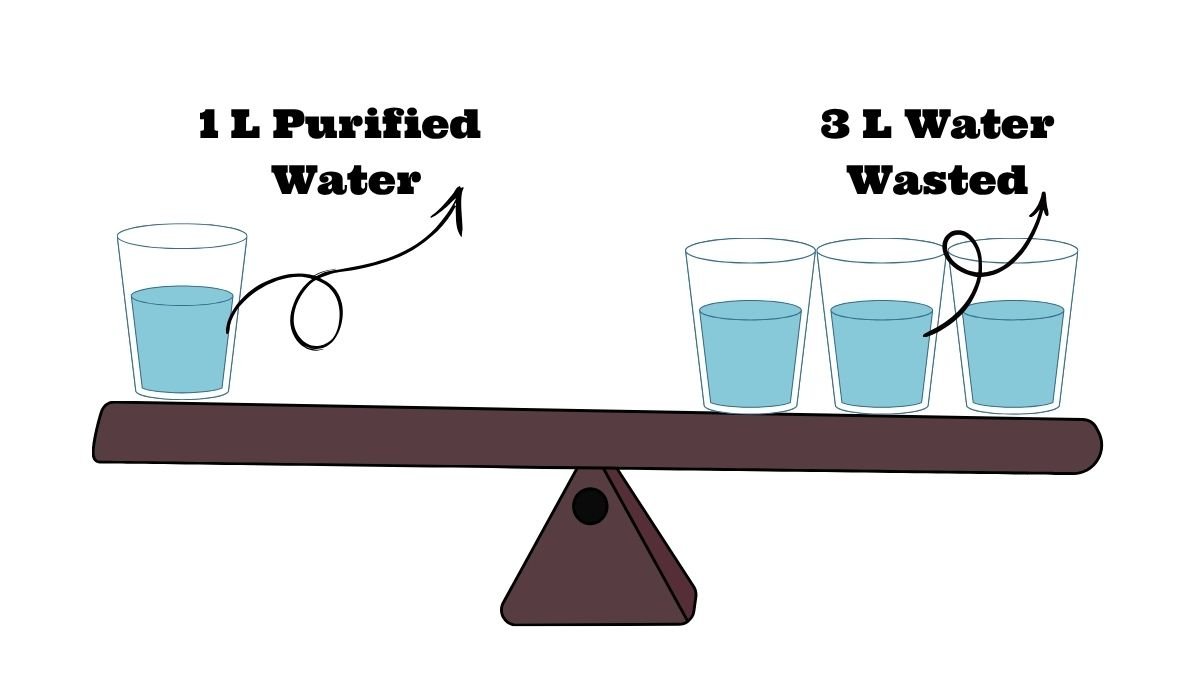
To understand this thing more clearly, the KENT Excel Plus, for the example, is throwing out nearly 650 ml of water for the every one litre it is purifying. This is a lot of water which is going straight down into the drain, especially in those regions where the water scarcity is a genuine and serious concern. Although some of the newer models, like the Aquaguard Select Designo, are claiming that they can save up to 40 litres of water per day when we compare it with the regular RO purifiers, but still the fundamental issue of the water wastage is remaining inherent inside the RO technology by itself. This happens because the RO membrane needs a certain amount of reject water to flush away the concentrated dissolved solids (TDS), otherwise the membrane will get choked very fast.
2. Installation can become a real headache
The under sink water purifiers of today are boasting compact design and also dedicated installation kit, which are meant for making the fitting more straightforward. But any person who already did one installation is knowing that it is not always so simple like that.
In the practical situation, the under sink installations are mostly facing the plumbing complications and also the space constraint problem. The existing pipe configuration, cabinet layout, and the drain placement, they tend to obstruct the whole process or making some unexpected delay. Few models are also having the difficulty for fitting inside the standard-size cabinet, more especially when you are counting the storage tank, the tubing, and one extra faucet also which need to be drilled onto the countertop.
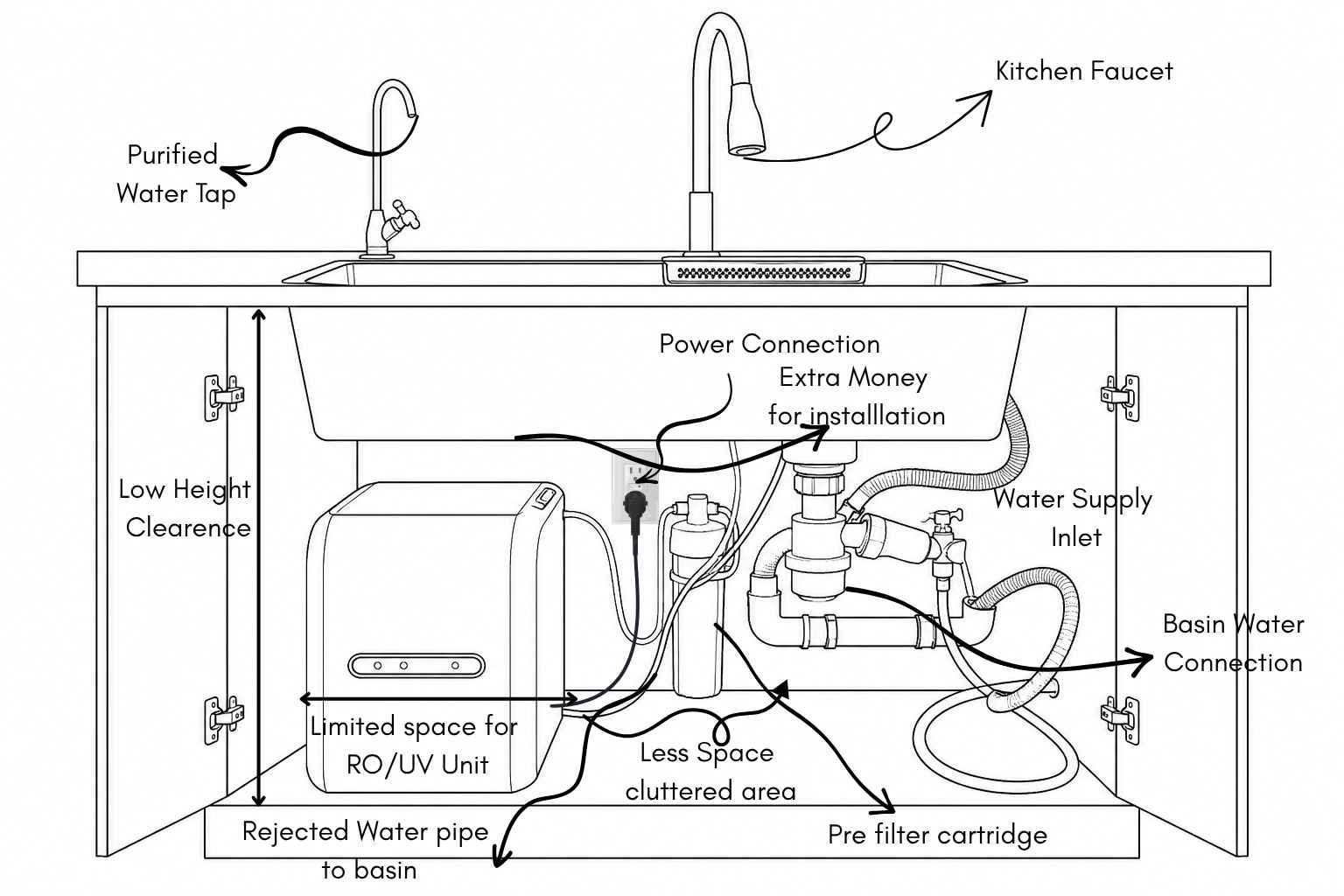
All of this is meaning that, before you can enjoy your purified water, first you must spend so much time for coordinating with the plumber or the technician. And this is becoming an extra hassle if you compare with the countertop model, which is more capable to just plug in and place at wherever place is convenient for you.
How much trouble your installation is involving, it will depend one part on your kitchen setup only. For the example, in case of the AO Smith Z2+, the dimension of 40.9 x 26.9 x 41.9 centimetre is meaning that you will be needing one fairly generous under-counter space, and not each and every kitchen cabinet is able to accommodate that thing so comfortably.
3. They need regular and costly maintenance
Under sink water purifiers are made to be quite low-maintenance if we compare them with some other alternatives, but still they are needing regular care and attention from you. You will have to replace the RO membrane, the UV lamp, the sediment filter, and also the carbon filters after some fixed time intervals, and also you must make sure that the whole system is getting flushed and serviced from time to time. Maybe one day in future the purifier will become smart enough to do all this by its own, but sadly we are still very far from reaching that point right now. So because of this, if you are neglecting the maintenance, then it can cause the purification performance to become reduced, or in worst case it can even lead to contamination of the output water which you are drinking.
This problem is not only limited to the under sink models, obviously, and the more costly units are coming with smart LED indicators and also filter change alerts. Take the example of AO Smith Z2+, it is having one dedicated filter change indicator which starts blinking to give you the signal that now the RO membrane or the other filters are needing replacement, so that the chances of you forgetting it becomes very less. But even after having all these reminders also, still you are going to face the regular service visits and the cost of replacement parts, which keeps on adding up slowly slowly over the time.
4. They’re completely dependent on electricity
Like we already told before, the under sink water purifiers are made for giving purified water whenever you want it. But the thing is, they are not so much self-sufficient in real: and because of this there is always one dependency on the non-stop electricity supply, which is meaning that no power is equal to no purified water. In the time of power outage, load shedding, or when voltage is going up and down, your purifier will simply not do any work. Also they can face difficulty with the power supply which is not consistent, and this thing can put effect on the life of some components like the booster pump and the UV lamp.
The models which are coming with hydrostatic storage tank, same as the KENT Excel Plus that is having its 7-litre tank, they do give some buffer. This pressurised tank is helping the supply of the purified water even when the running water and the electricity both are not there, at least till the time the tank is not getting empty. But this one is more like a workaround only and not a proper solution, and if you are staying in such area where the power cut is happening frequently, then you will be feeling this limitation very much sharply.
5. There are limited storage and flow rate concerns
Some advanced under sink water purifier are offering relatively modest storage tank and flow rate, if we see the price which you are paying. This makes them suitable for the small family only, which is reducing the impact for some of the households. But still it raise the question about is it enough for the larger family or the heavy usage condition, mostly during the gathering time or when the cooking is requiring large volume of purified water.
The AO Smith Z2+ is giving only 5 litres of storage, while the KENT Excel Plus is providing 7 litres, and the Aquaguard Select Designo is coming with 8 litres. The flow rate is around 15 litres per hour in all the three models, which is sounding reasonable but it can feel limiting when the multiple family member need the water at same time. If the tank become empty, then you are left for waiting till the system purify and refill again, and that waiting, during a busy morning or the dinner party time, can be truly frustrating.
Is an under the sink or wall mounted RO water purifier right for you?
I would suggest an under the sink RO purifier in case you want:
I would suggest a wall mounted RO purifier in case you want:
FAQs
An under the sink RO purifier is placed under the sink cabinet and the water is dispensed via a separate faucet. RO purifier is a wall mounted purifier that is attached to the wall and has a built-in dispenser. The two are similar in purification, however, installation and accessibility varies greatly.
RO+UV+UF purification is a combination of Reverse Osmosis (RO), Ultraviolet (UV) and Ultra Filtration (UF) technologies. RO, UV, and UF remove dissolved impurities, bacteria and viruses, and fine suspended particles respectively. They are used together to give complete purification of water.
An under the sink RO purifier is usually the superior option in case you have a modular kitchen. It ensures that the countertop and walls are not cluttered and it has a smooth modern appearance.
Yes. A RO purifier can be mounted on the wall of a small kitchen, though it requires a sufficient amount of space on the wall. In case there is not enough space in the cabinet, a wall mounted unit may be a viable option as it does not need under-sink storage.
Yes. The sink RO purifiers are usually installed by the professionals because of the plumbing connexions and the separate faucet system. The majority of brands provide free installation as a service plan.
Yes, but only of certain models. There are wall-mounted and countertop RO purifiers that have the option of hot water dispensing. These models are fitted with heating components and release water between 45°C to 80°C.
We’ve explained all the key details about Water Purifiers with Hot and Cold, including the best picks.



Maam, I have a TDS of 280-300 in my house from MCD water. I Need under the sink, do I need RO as I am told minerals are lost. Do I buy UV / UF. Someone was saying nano filters are coming now. Which one to buy confused and which company